Is the NFL Football Bigger Than a College Football? Size Differences Explained
Ask almost anyone who grew up tossing a football in the backyard, and they’ll tell you a football is a football. Same shape, same smell of leather, same satisfying spin when you get the release just right. And at a glance, watching a Saturday college game and then flipping to an NFL game on Sunday, the ball looks identical on screen.
But it’s not. Not exactly.
The NFL football is, technically, slightly bigger than what’s used in most college games. That “slightly” is doing a lot of work in that sentence, though, because the gap is narrow enough that most casual fans would never notice by sight alone. It takes measuring tools, a rulebook, and maybe a confession from an elite receiver who just dropped three passes in the preseason to bring the difference into sharp focus.

So let’s get into it, not just the raw measurements, but what those numbers actually mean for the players throwing the ball, catching it, and adjusting to a new level of competition.
The Official Measurements: NFL vs. College
The NFL football has tight, non-negotiable specifications. According to the NFL rulebook, every game ball must be between 11 to 11.25 inches long, with a long circumference (measured end to end along the ball’s length) of 28 to 28.5 inches, and a short circumference (measured around the belly of the ball) of 21 to 21.25 inches. Weight must fall between 14 and 15 ounces, and internal pressure must sit at 12.5 to 13.5 psi.
Those numbers don’t budge. Every NFL ball is a Wilson, hand-selected, bearing the Commissioner’s signature, and crafted at Wilson’s factory in Ada, Ohio. The consistency is rigid by design.
College football operates under looser tolerances. The NCAA permits balls that are 10.5 to 11.25 inches long, with a long circumference ranging from 27 to 28.5 inches and a short circumference of roughly 20.75 to 21.25 inches. In practical terms, this means some college balls can be noticeably smaller than an NFL ball, while others fall right at the same dimensions. It depends heavily on the manufacturer and the specific program.
The bottom line: the NFL’s minimum specifications are larger than the NCAA’s minimum specifications, and the NFL’s tolerances are considerably tighter. A college ball could be up to half an inch shorter in length than the minimum legal NFL ball, or it could match it exactly. There’s real variation in the college game that simply doesn’t exist at the professional level.
Why the College Ball Has More Variation

The NFL has one official ball manufacturer. One. Wilson has held that exclusive contract for decades, and every single game ball is made to the same exacting standard in the same factory in Ohio. The uniformity is intentional and absolute.
College football is a different world entirely. The NCAA doesn’t mandate a single manufacturer. Programs choose their own equipment partnerships, which means a game at one stadium might use a Wilson GST while a game across the country uses a ball from a different maker with slightly different dimensions, different leather, and a different feel in the hand.
This isn’t chaos, exactly. The NCAA does set a size range that all balls must fall within. But within that range, there’s meaningful room for variation. A receiver at a large program in one conference might spend four years catching a ball that sits on the smaller end of the legal spectrum, then get drafted and suddenly find himself trying to haul in a noticeably larger, heavier, denser ball in NFL training camp.
That adjustment is real, and players have talked about it publicly.
Ja’Marr Chase, Preseason Drops, and What They Tell Us
In August 2021, Cincinnati Bengals wide receiver Ja’Marr Chase had a rough preseason. Drops. Multiple notable drops. Chase had just been the fifth overall pick in the draft after a standout career at LSU, where he was considered one of the most polished route runners in college football. His hands were not supposed to be a question mark.
His explanation for the drops was revealing: he said the NFL ball is harder to catch than the NCAA ball, and not just in terms of the size adjustment. He specifically mentioned the white stripes.
College footballs have two white stripes painted near each end of the ball, roughly three to three-and-a-quarter inches from the tip. NFL footballs have no stripes at all. Chase said he found the NFL ball harder to track in the air without those visual markers, particularly in poor lighting conditions. His eyes, trained for years to pick up a rotating ball with stripe cues, were being asked to recalibrate.
It sounds almost comically minor. Missing white paint stripes is throwing off an elite athlete’s performance. But the human eye is remarkably good at tracking rotation patterns, and those stripes serve as visual anchors during a ball’s flight. Remove them, and the adjustment is subtle but real, especially at the speed the NFL game moves.
Chase’s drops largely disappeared once the regular season started. But his candid explanation opened a window into just how seriously the physical differences between the two levels affect even the most gifted players.
The White Stripes: Functional or Just Tradition?
This question comes up a lot. Do the white stripes on a college football serve a practical purpose, or are they just a visual tradition carried forward from older versions of the game?
The honest answer appears to be: both, depending on who you ask.
Historically, the stripes were added to improve visibility, particularly in night games and low-light conditions when tracking a dark leather ball against a dim sky was genuinely difficult. The stripes broke up the ball’s silhouette and gave players a reference point during flight.
Whether modern lighting technology has made the stripes functionally unnecessary is debatable. Many coaches and former players maintain that the stripes still help receivers and defenders track the ball’s rotation. Others argue the visual benefit is minimal at this point, and the NFL’s unstriped standard hasn’t created any meaningful tracking issues at the professional level.
What’s clear is that removing the stripes is a genuine adjustment, not a trivial one, for college players stepping up to the pro game. The visual experience of catching a pass changes, and muscle memory built over thousands of repetitions with a striped ball doesn’t transfer automatically.
Pressure and Feel: The Tactile Difference
Ball size and visual markings aside, there’s a tactile component to the NFL ball adjustment that doesn’t get discussed as often as it probably should.
NFL rules require game balls to be inflated to between 12.5 and 13.5 psi. This was, of course, at the center of the infamous Deflategate controversy in 2015, which made most football fans more aware of psi requirements than they’d ever expected to be. The specific range exists because ball pressure significantly affects grip, stiffness, and how the ball deforms on contact with a hand or finger.
College ball pressure specifications are somewhat less standardized across programs. The NCAA rulebook sets its own pressure requirements, but the variation in manufacturers and conference standards means the tactile feel of a game ball can differ from program to program, even within the same level.
A quarterback who spent four college seasons throwing a ball inflated to the lower end of his program’s specifications may find the NFL ball feels slightly firmer and less pliable in cold weather. In warm conditions, the difference is negligible for most players. But at 30 degrees in a late-season game, a fraction of a difference in stiffness can affect how cleanly a ball leaves the hand on a tight spiral.
Does It Actually Matter at the Top Level?
Both NFL and college footballs fall within the 14 to 15 ounce range, which means weight is one area where the two levels are essentially aligned. The NFL’s specifications don’t allow for significant weight variation, and most college programs use balls that fall within the same general window.
For quarterbacks making the transition to the pros, weight is generally not the primary adjustment concern. The size and feel differences tend to be more noticeable than any weight variation. That said, even a small difference in where the weight is distributed within the ball — which can vary based on the lace placement, bladder construction, and leather thickness — affects the feel of a throw, particularly at the point of release.
The NFL’s Wilson Duke ball has a specific internal construction designed to maintain consistent weight distribution across thousands of uses. College balls, manufactured by multiple companies, may have subtle differences in internal construction that affect how evenly weight is distributed through the ball’s lifespan.
The Laces: Grip and Release Mechanics
Both NFL and college balls use leather laces, and both follow the same general lace pattern. But the type of leather used, the lace’s thickness, and the stitching beneath can vary by manufacturer.
Wilson’s college GST ball uses what the company calls ACL laces, which are slightly wider and designed to improve grip during release. The NFL’s Duke ball uses a slightly different lace configuration. For a receiver catching passes, the laces don’t matter much. For a quarterback throwing them, lace placement and texture are things elite players notice instantly.
Most NFL quarterbacks develop very specific grip preferences and can immediately feel when something about a ball’s lace configuration is off from what they’re accustomed to. This is part of why NFL teams are allowed to work with their game balls before kickoff, allowing quarterbacks to break in the leather slightly to their personal preference before the ball enters official play.
How the Size Difference Affects Different Positions
The impact of the NFL ball’s size and feel specifications isn’t uniform across positions. Different player roles interact with the ball in different ways, and the adjustment required varies considerably.
For Quarterbacks
For most quarterbacks, the size difference between a college ball and an NFL ball is real but manageable. The tighter tolerances of the NFL ball mean that every snap, every throw, every wet or cold-weather game is encountered with a ball that behaves predictably. College quarterbacks used to variable ball specifications across their career may actually find the consistency of the NFL ball a relief in some ways, even if the size adjustment takes a few weeks.
The bigger adjustment for quarterbacks is typically the overall pace of the NFL game, the strength of pass rushers, and the sophistication of defensive coverages rather than the ball itself. That said, a quarterback with smaller hands may find the NFL ball’s tighter minimum size more challenging than the college ball’s flexibility allowed.
For Wide Receivers and Tight Ends
Wide receivers and tight ends tend to notice the adjustment most acutely, for the reasons Ja’Marr Chase articulated publicly. The absence of white stripes changes the visual tracking experience. The slightly larger, denser ball may require marginal grip adjustments on contested catches, particularly when catching against a defender’s hands. Route runners who practiced precise hand placement for years on a slightly smaller college ball sometimes find that their hand positioning needs to shift when the ball’s dimensions change.
This rarely becomes a career-altering issue, but it does show up in preseason performance and explains why even highly touted receivers occasionally have uncharacteristic drop rates in their first NFL training camp.
For Long Snappers and Kickers
This may seem like a niche consideration, but long snappers and kickers interact with the ball in highly specific, precision-dependent ways. A long snapper’s release mechanics are calibrated for a specific ball weight and size. A kicker’s plant foot, approach angle, and strike point are all tuned to the feel of a specific ball.
Both specialists tend to report that the NFL ball adjustment is something they work through carefully in the preseason, rather than something they simply assume will take care of itself. The consistency of the NFL ball actually benefits these specialists over time, because once they calibrate to it, it behaves the same way in every game.
Size Comparison Across All Football Levels
It helps to place the NFL and college ball in context by looking at the full progression of football sizes from youth leagues through the professional level.
Pee Wee footballs, used by the youngest players, have a long circumference of roughly 23.25 inches and weigh about 9.7 ounces. Junior footballs for players around ages 9 to 12 run about 25.375 inches in circumference and weigh approximately 10.7 ounces. Youth footballs for ages 12 to 14 step up to roughly 26.5 inches in circumference and weigh around 12.7 ounces.
High school footballs generally match the college size classification, running between 10.5 and 11.5 inches in length with approximately 28 inches of long circumference and 14 to 15 ounces of weight. College balls fall in essentially the same range, though with the manufacturer variation discussed earlier.
The NFL ball sits at the top of this progression, locked into its 11 to 11.25-inch length and 28 to 28.5-inch circumference. The progression from youth to high school to college to pro is deliberately gradual, with each step asking a developing player’s hands to adjust incrementally rather than face a dramatic jump all at once.
That deliberate progression is part of why the gap between college and NFL balls is intentionally small. The goal isn’t maximum challenge; it’s appropriate development.
The Wilson Duke: More Than Just a Name
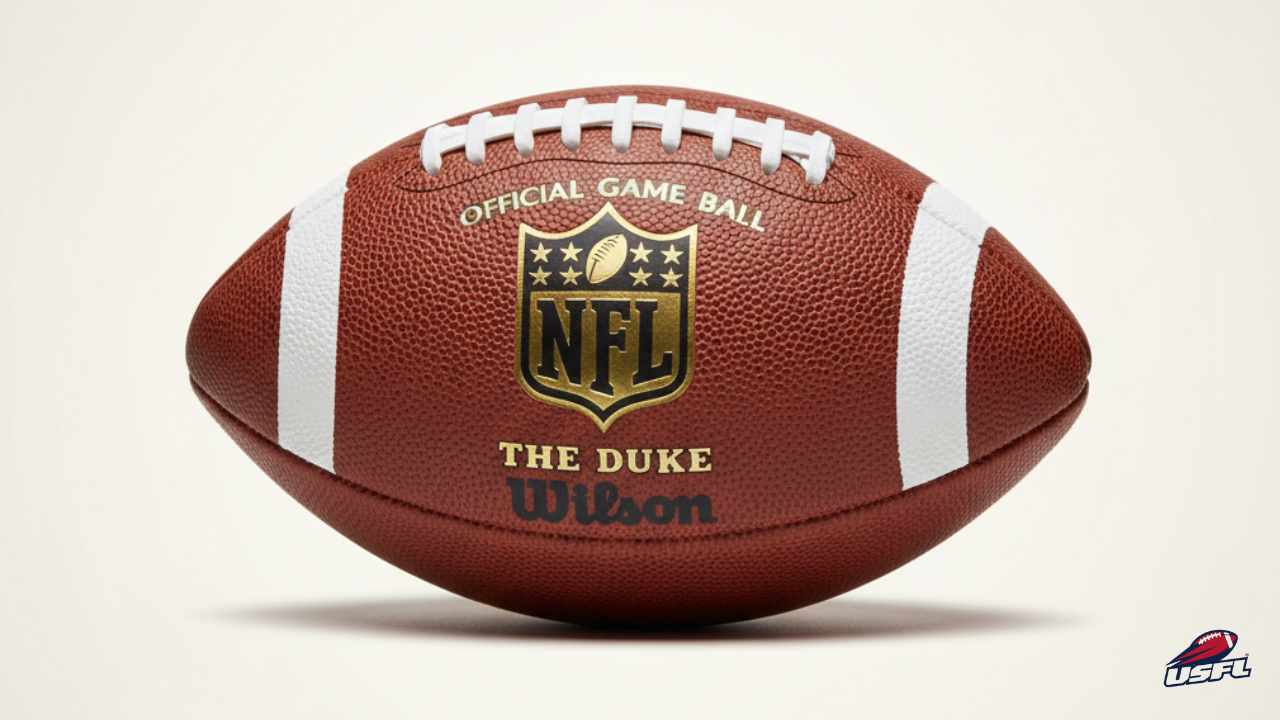
The Wilson Duke is the official NFL game ball, and it carries a name with genuine history. Wellington Mara was a young boy who grew up around the New York Giants in the early days of professional football. The players nicknamed him “The Duke,” and when Wilson began manufacturing the official NFL ball, the name followed.
Every Wilson Duke is handcrafted at the Ada, Ohio, facility. The process involves selecting specific panels of leather, applying a special tanning process, shaping the panels over a mold, hand-lacing the ball, and then inflating and inspecting each one individually. The labor involved is substantial for what amounts to a piece of game equipment that may only last a handful of plays before being retired from official use.
This level of craftsmanship and consistency doesn’t exist at every college program, and it doesn’t need to. But it does mean the NFL’s ball represents a precision standard that college equipment simply isn’t held to in the same way.
Does Ball Size Actually Affect Game Outcomes?
Here’s a fair question that doesn’t get asked enough: Does the measurable size difference between a college ball and an NFL ball meaningfully affect game outcomes, or is this all really about player adjustment during the transition period?
The honest answer appears to be: almost entirely the latter. Once players adapt to the NFL ball, and most do relatively quickly, the size difference stops being a factor. The game’s outcomes at the pro level are shaped by the quality of the athletes, the sophistication of the schemes, the health of key players, and the strategic decisions coaches make. Not by fractions of an inch in ball circumference.
Where ball size does matter is specifically during the transition window. A receiver who drops passes in August preseason games because he’s adjusting from college ball might slip on a depth chart, affecting his opportunity to contribute and potentially his early career trajectory. A quarterback who needs two or three regular-season games to fully calibrate to the NFL ball’s feel may show inconsistency that creates questions about his readiness.
So while ball size doesn’t determine outcomes between two fully adjusted NFL teams, it could influence how quickly a rookie reaches their professional ceiling. That makes it worth taking seriously, even if the measurements look minor on paper.
Common Questions About Football Sizes
Is the NFL ball heavier than a college football?
Both the NFL and college football fall within the same 14 to 15 ounce weight range, so weight is not a significant differentiating factor between the two levels. The more notable differences lie in length, circumference, and the consistency of manufacturing standards.
Why do college footballs have white stripes and NFL footballs do not?
College footballs feature two white stripes near each end of the ball, a design originally intended to improve visibility and help players track the ball’s flight and rotation. The NFL removed the stripes decades ago and has maintained the unstriped standard since. Players transitioning from college to the NFL often cite the absence of stripes as a genuine visual adjustment, particularly in challenging lighting conditions.
What is “The Duke” NFL football?
“The Duke” is the official name of the NFL game ball, manufactured exclusively by Wilson at their factory in Ada, Ohio. The name honors Wellington Mara, the longtime New York Giants owner who was nicknamed “The Duke” as a child. Every official NFL game ball is a Wilson Duke, hand-selected and bearing the NFL Commissioner’s signature.
Do college quarterbacks struggle with the NFL ball?
Some do, at least initially. The slightly larger and more consistently sized NFL ball, combined with the absence of the familiar white stripes, can require a brief adjustment period. Most elite quarterbacks calibrate to the NFL ball quickly, with the bigger professional transition challenges typically involving the speed of the game, the quality of opposing defenses, and the complexity of playbooks rather than the ball itself.
Are high school footballs the same size as college footballs?
Generally, yes. High school footballs fall within the same size classification as college footballs, typically referred to as a “size 9” ball. Both run between 10.5 and 11.5 inches in length with approximately 28 inches of circumference. The NFL ball sits at the tighter, slightly larger end of this range with more rigidly enforced specifications.
The 2026 Perspective: Where This Conversation Is Heading
There has been ongoing discussion within football circles, particularly among player development coaches and college athletic directors, about whether further standardizing the college football specification to more closely align with the NFL’s standard would better prepare players for the professional transition.
The argument makes logical sense. If the goal of NCAA football includes developing athletes for the professional level, using a ball that more consistently matches what they’ll encounter in the NFL could reduce at least one variable in a transition that already involves countless adjustments.
The counterargument is that the college game has its own identity, its own traditions, and its own purposes that aren’t limited to serving as a pipeline to the NFL. The white stripes, the manufacturer variation, the slightly looser specifications — these are part of the college game’s distinct character. Harmonizing everything to NFL standards could feel like the professional league absorbing the amateur one.
As of 2026, no formal proposal to standardize college ball specifications to NFL dimensions has advanced through the NCAA’s legislative process. The college game continues with its current tolerances, and the transition adjustment continues to be something elite prospects manage during the preseason. It’s a small thing, but in a sport where margins are everything, small things tend to matter more than anyone initially expects.

Leave a Reply