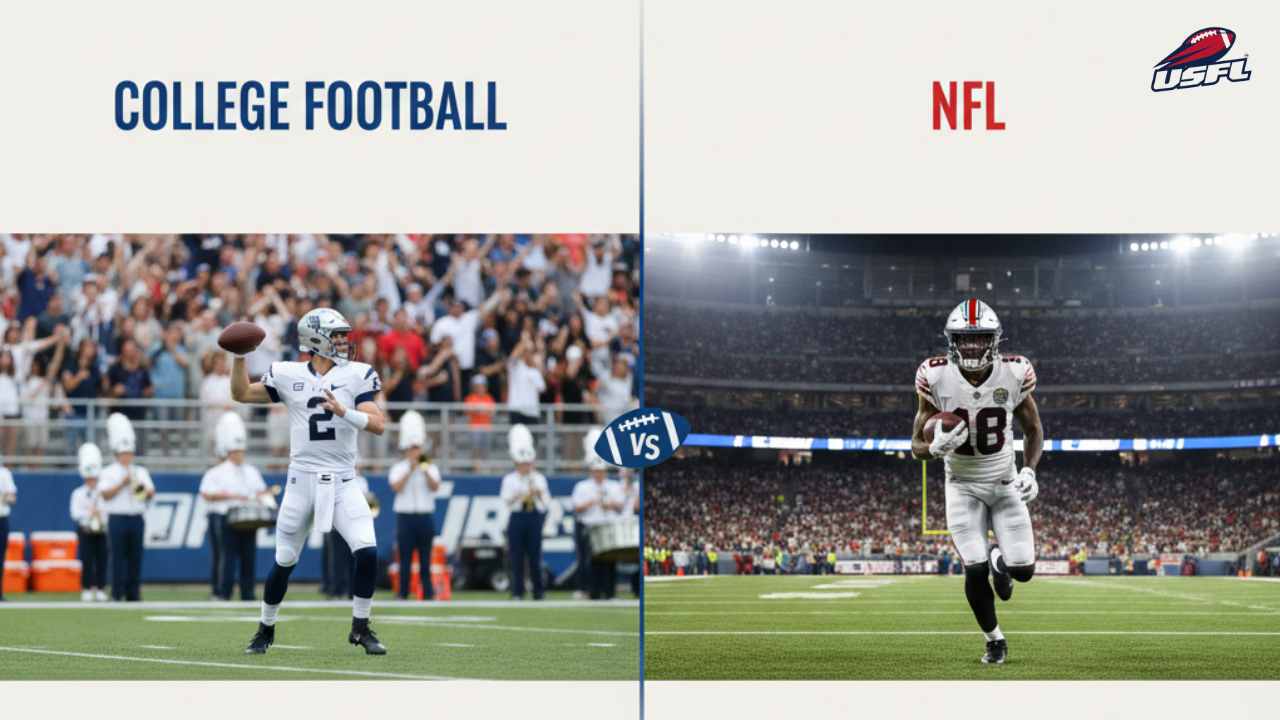
College Football vs NFL Rules: What Are the Key Differences?
If you’ve ever flipped between a Saturday college game and an NFL broadcast on Sunday and felt like something was slightly off, you’re not imagining things. The two versions of American football share the same bones, the same field, the same helmets and pads, and most of the same basic rules. But dig a little deeper, and you’ll find a collection of meaningful differences that change how games are played, how coaches call plays in crucial moments, and how players have to completely rewire their instincts when they make the leap from NCAA competition to the professional level.

This isn’t just trivia for the most hardcore fans. Understanding these rule variations helps explain why certain plays work in college that simply wouldn’t survive at the pro level, and why some elite college receivers struggle early in their NFL careers despite being physically gifted. The rules shape the game in ways that aren’t always obvious on first watch.
Why the Rules Are Different in the First Place
Before getting into specific rules, it’s worth understanding the context. College football is governed by the NCAA (National Collegiate Athletic Association), while the NFL (National Football League) operates under its own separate rulebook maintained by the league’s Competition Committee. These two bodies have different goals and priorities.
The NCAA is, at least in principle, managing a system built around student-athletes. The rules reflect that, including a pace of play, overtime format, and clock management approach that differ noticeably from the professional game. The NFL, on the other hand, is a business. It’s built for television, for consistent entertainment, and for a product that prioritizes precision and strategy among the world’s best players. Those different philosophical foundations explain a lot of the rule gaps you’ll notice.
Key Rule Differences Between College Football and the NFL

Overtime Rules
- College Football: Each team gets the ball at the opponent’s 25-yard line. After two overtimes, teams must attempt two-point conversions only.
- NFL: Teams play 10-minute overtime periods; a touchdown on the first drive ends the game. If both teams score, the next score wins.
College OT is possession-based; NFL OT is timed and sudden-death oriented.
The Catch Rule: One Foot vs. Two Feet
This is probably the most widely discussed difference between the two levels, and for good reason. It affects a receiver’s body positioning on nearly every single sideline route.
In college football, a receiver only needs to get one foot in bounds while maintaining control of the ball for the catch to count. In the NFL, the requirement is two feet in bounds, and the receiver must also maintain possession through what the rules describe as the “process of the catch.”
That extra foot might sound like a minor detail. It’s not. The two-foot requirement in the NFL has produced some of the most controversial and debated plays in recent memory. The 2014 Dez Bryant non-catch against the Packers and the 2017 Jesse James play against the Patriots both came down to this exact standard. College catches that would generate highlights on Saturday become incompletions on Sunday. Quarterbacks have to adjust their throw placement to give receivers a better chance of getting both feet down, and receivers have to train their footwork specifically for the professional standard.
Young NFL receivers who spent their college careers getting comfortable with the one-foot rule sometimes find their first professional season harder than expected, not because of athletic ability but because a deeply ingrained physical habit suddenly works against them.
Down by Contact: A Rule That Changes Everything About Ball Security
Here’s a rule difference that coaches obsess over when transitioning players from college to the pros, and yet casual fans rarely notice it.
In college football, a player is ruled down the moment any part of their body other than their hands or feet touches the ground — regardless of whether a defender made contact. Slip on the turf? Play over. Land awkwardly, and your knee grazes the grass? Whistle blows. It doesn’t matter if anyone touched you.
In the NFL, a player is only considered down if a defender makes contact before or as they hit the ground. That means if a ball carrier slips, trips, or falls without contact, they can get back up and keep running. This rule creates occasional chaos at the pro level when defenders don’t bother to tag down a falling player, assuming the whistle will blow, and then watch the ball carrier pop up and gain 15 more yards.
It also creates strategic coaching moments. NFL defensive coaches routinely drill their players to always tag down a ball carrier, even if it looks obvious that the play is over. The college game eliminates that entirely, because the contact rule doesn’t apply.
Hash Marks: The Hidden Structural Difference
This one doesn’t get nearly enough attention in mainstream football conversation, but it may be the most strategically significant physical difference between the two levels.
Hash marks are the short yard-line markers near the center of the field that determine where the ball is spotted at the start of each play. In the NFL, the hash marks are just 18 feet, 6 inches apart. In college football, they sit 40 feet apart — much wider.
What does that mean in practice? In the NFL, every snap begins near the middle of the field, with roughly equal space on both sides. Defensive coordinators can set up balanced formations and know that neither side of the field has a dramatic space advantage. The offense and defense face each other in a relatively symmetrical environment.
College football is fundamentally different because of those wider hashes. When the ball is spotted on a college hash mark, one side of the field has significantly more open space than the other. That’s why you see more wide-field runs and specific passing schemes in college that appear to exploit space in ways that simply don’t translate to the pro game. The geometry changes everything. A play that looks like a genius design in the college game may fall apart in the NFL because the field geometry no longer supports it.
This is a major reason why spread offense concepts developed in college have had to be modified considerably when NFL offensive coordinators try to adopt them. The field just doesn’t behave the same way.
Overtime Rules: Two Very Different Philosophies
The overtime format is where the philosophical gap between college and professional football becomes most visible and most debated.
How College Football Overtime Works
NCAA overtime operates as an alternating possession format. Each team gets the ball at the opponent’s 25-yard line with a fresh set of downs and no game clock running. Both teams get an equal chance to score in each overtime period. If the game is still tied after two overtime periods, teams are required to attempt two-point conversions instead of extra points after scoring touchdowns. By the third overtime, it becomes a straight alternating two-point conversion battle until one team converts and the other doesn’t.
College overtime tends to be high-scoring and fast-paced. Critics call it a gimmick because it doesn’t resemble regulation football. Supporters argue it’s fairer because both teams always get a possession.
How NFL Overtime Works
The NFL uses a modified sudden-death format with a 10-minute period in the regular season. The team that wins the coin toss can win immediately if they score a touchdown on their opening possession. If they score only a field goal, the other team gets a chance to respond. If neither team scores within the 10-minute window, the regular-season game ends in a tie. In the postseason, overtime continues until a winner is determined, using the same structure but without a time limit.
One practical consequence: NFL regular-season games can end in a tie, which feels strange to most football fans. College games cannot. There have been 29 tied NFL games since 1974. It’s rare, but it happens, and the 10-minute cap makes it possible.
Clock Management: Subtle but Significant
The game clock rules between the two levels differ in ways that dramatically affect late-game strategy, two-minute drills, and a coach’s timeout decisions.
In college football, the clock temporarily stops after a first down to allow the chain crew to reset. This is a brief pause, but it adds up across a game, which is partly why college games feature more plays per contest and often run longer overall. In 2024, the NFL averaged around 22.9 points per team and shorter game durations, while college games regularly featured 175 plays or more.
The NFL clock keeps running after a first down unless a timeout is called or the ball carrier goes out of bounds. Starting in 2025, the NFL also installed a virtual first-down measurement system to speed up close calls, but the running clock principle remains intact.
This difference matters most in the final two minutes of a half. A college team trailing by 10 with 90 seconds left has more realistic comeback opportunities because the clock stops after each first down, giving the offense essentially free clock management. In the NFL, every tick counts, and teams have to carefully conserve timeouts for precisely those moments.
The two-minute warning is another NFL-specific clock mechanic. It automatically stops play at exactly the two-minute mark of each half, regardless of what’s happening on the field, giving both teams a strategic pause. College football has no equivalent. A coach calling plays in a tight college game has to account for this absent structure, managing the clock entirely through timeouts and out-of-bounds plays.
Pass Interference: The Spot Foul That Changes Everything
Defensive pass interference (DPI) is enforced very differently between the NFL and college, and the gap is enormous.
In the NFL, pass interference is a spot foul, meaning the ball is placed at the exact location where the foul occurred. On a 50-yard bomb downfield, that’s a 50-yard penalty. If the infraction happens in the end zone, the ball is placed at the 1-yard line. It’s the single largest potential penalty in the professional game and one of the most controversial calls in officiating.
College football caps pass interference at 15 yards, regardless of where the foul took place. A defensive back can hold a receiver on a deep route and give up just 15 yards instead of potentially half the field. This rule meaningfully affects how defensive coordinators call coverage at the college level. A cornerback in a college game might take calculated risks in coverage that an NFL corner simply cannot afford.
This difference also affects how fans and analysts evaluate defensive backs. A college cornerback with a tendency to hold or make physical contact downfield may look controllable in the NCAA, but that same habit becomes cripplingly expensive in the professional game.
The Extra Point and Field Goal Distance
Extra points are physically easier in college than in the NFL. In the NFL, the ball is placed at the 15-yard line for an extra-point kick, which translates to a 32-yard attempt once you account for the depth of the end zone and the kicker’s position. In college football, the ball is placed at the 3-yard line, making it a 20-yard kick.
That’s a significant difference in difficulty. NFL kickers miss extra points at a measurably higher rate than college kickers, partly because of this distance gap. It’s one reason why two-point conversions carry more strategic weight in the NFL. A coach who feels uncertain about his kicker’s range on a pressure kick may factor that into game-planning in ways a college coach rarely has to consider.
Kickoff Rules: Two Different Systems Entirely
In 2024, the NFL introduced a new dynamic kickoff format designed to bring back exciting kickoff returns while reducing high-speed collisions. Under this rule, the kicking team cannot start running downfield until the ball is touched by the returner or hits the ground in the landing zone. Players line up in stationary positions until that trigger occurs.
College football still uses the traditional kickoff format, where the kicking team can sprint downfield the moment the ball is kicked. This creates more space and more opportunities for big returns, but it also means faster closing speeds and more collision risk. The NFL’s shift away from this model in 2024 represents one of the bigger structural game changes the league has made in recent years.
Instant Replay and Booth Reviews
The approach to instant replay also diverges meaningfully between the two levels.
In college football, officials in a review booth can initiate a review of any play on the field. The college game has centralized booth review as a standard feature of officiating.
In the NFL, automatic review applies only to scoring plays and turnovers. Coaches are allowed two challenges per game, with a third challenge granted if both previous ones succeed. Clock-related plays in the final two minutes of each half are automatically reviewed, but coaches cannot challenge those plays themselves.
The difference matters because questionable non-scoring plays in the NFL can only be corrected if a coach burns a timeout to challenge. A close first-down spot, a potential illegal contact away from the ball, a borderline false start — these plays may go uncorrected at the professional level when they might get a second look in college.
Roster Size and Team Composition
NFL teams carry 53-man active rosters, with 46 players eligible to dress on game day and additional practice squad players on hand. College programs can carry up to 85 scholarship players and typically have larger overall rosters when walk-ons are included.
This gap in roster depth changes how both sides manage injuries, matchups, and substitution packages. NFL teams have to be precise about which positions they invest in because every roster spot carries financial implications. College programs, by contrast, can maintain deep depth charts at multiple positions and rotate players more freely.
Player Eligibility, Transfers, and the NIL Era
The player composition rules at the two levels are fundamentally different, and this area has changed significantly in recent years.
NFL roster movement is governed by the standard draft, free agency, trades, and contract system that most fans are familiar with. Players are professionals under contract, and their movement follows negotiated agreements and collective bargaining rules.
College football has undergone a significant transformation in this area. The transfer portal has changed how player movement works at the NCAA level, allowing athletes to transfer between schools more freely than ever before. The introduction of NIL (Name, Image, and Likeness) compensation starting in 2021 fundamentally changed the amateur model that the NCAA had maintained for decades. College athletes can now earn money through endorsements, appearances, and business deals while still maintaining eligibility.
This has blurred some of the traditional distinctions between the amateur and professional game in terms of financial incentives, but the core rulebook differences on the field remain unchanged.
Ball Specifications: A Small Difference Worth Knowing
The physical footballs used at the two levels are slightly different. College footballs are a touch smaller and feature white stripes near each end. NFL footballs are slightly larger, heavier, and carry no stripes. The stripes on college balls are largely a visibility aid, a tradition that goes back decades.
For most skill positions, the size difference is minor. But for quarterbacks transitioning from college to the pro level, some report that the slightly larger NFL ball takes adjustment, particularly in cold weather, when a larger ball can feel noticeably different in the hand.
How These Differences Affect the Transition from College to the NFL
The most practical question these rules raise is: what does it mean for a college player making the jump to the pros?
The catch rule is probably the first thing receivers notice. Catching balls near the sideline requires retraining footwork from the ground up. The down by contact rule changes how ball carriers think about contact and falling. Wider hash marks disappear, which means plays designed around college field geometry don’t translate cleanly. The clock continues running after first downs, requiring quarterbacks to develop a more urgent pace of play.
Most importantly, the absence of that clock stoppage after first downs means no-huddle and hurry-up offenses in the NFL require a different kind of mental preparation. There’s simply less time between plays, less organizational breathing room.
Players who understand these differences before entering the league tend to adapt faster. The ones who treat it purely as the same game they’ve been playing tend to struggle early.
College Football vs NFL: A Quick Comparison of Core Rules
To bring all of this together without reducing it to a flat summary: these two versions of American football exist on a spectrum. College football leans toward openness, more plays, more scoring variation, and a looser structural framework that creates a different kind of entertainment. The NFL leans toward precision, tighter clock management, and a game environment where every rule is calibrated around the world’s best athletes playing in the tightest competition on earth.
Neither version is superior. They’re different games wearing the same uniform. A fan who understands both sets of rules watches Saturday and Sunday football with an entirely different lens.
Common Questions About College vs NFL Rules
Is it easier to score in college football than the NFL?
Generally, yes. The wider hash marks give offenses more predictable space to exploit, the one-foot catch rule leads to more completions near the sidelines, and the clock stopping after first downs gives offenses more time to execute. College teams averaged over 22.9 points per team in 2024, matching the NFL average, but college offenses benefit from significantly more plays per game.
Why does college football stop the clock after a first down?
The clock stops to allow the chain crew to reset the first-down markers. It’s a procedural pause that happens to give the offense a small time benefit, particularly in late-game situations. The NFL does not stop the clock for this same reason, which is part of why NFL games have fewer total plays despite having the same four 15-minute quarters.
Can an NFL game end in a tie?
Yes. In the regular season, if neither team scores during the 10-minute overtime period, the game ends in a tie. College football does not allow ties; overtime continues until a winner is decided.
What happens in college football overtime after two periods?
After two overtime periods, each team must go for a two-point conversion after any touchdown instead of kicking the extra point. Starting in the third overtime, teams alternate two-point conversion attempts only, without full possessions, until one team converts and the other doesn’t.
Why is pass interference less penalized in college football?
In college, defensive pass interference is capped at a 15-yard penalty regardless of where the foul happens. The reasoning is that the spot foul used in the NFL could disproportionately swing a game on a single deep-ball attempt. The college approach accepts a trade-off: it protects defenses from catastrophic penalties, but it also allows defensive backs to be more physically aggressive on deep routes than NFL rules would ever permit.
The 2026 Landscape: How These Rules May Continue to Evolve
Both the NCAA and NFL review their rulebooks regularly, and 2025 and 2026 have seen continued adjustments. The NFL’s new kickoff format, introduced in 2024 and refined for 2025, represents one of the bigger structural changes in recent memory. There has been ongoing discussion at the NCAA level about whether to adopt a two-foot catch standard similar to the NFL to better prepare college players for the professional game, though no formal change has been adopted as of 2026.
The NIL revolution in college football continues to reshape the amateur framework in ways that may eventually have downstream effects on scheduling, player welfare rules, and potentially even gameplay regulations. Meanwhile, the NFL’s virtual first-down measurement system introduced in 2025 removes one small area of officiating imprecision that had frustrated coaches and players for decades.
The two games will likely remain distinct for the foreseeable future. The NFL has no particular incentive to adopt college overtime or widen its hash marks, and the NCAA will probably continue to resist full alignment with NFL standards simply because the college game has its own identity, traditions, and audience that value what makes Saturday football distinctly different from Sunday.

Leave a Reply